
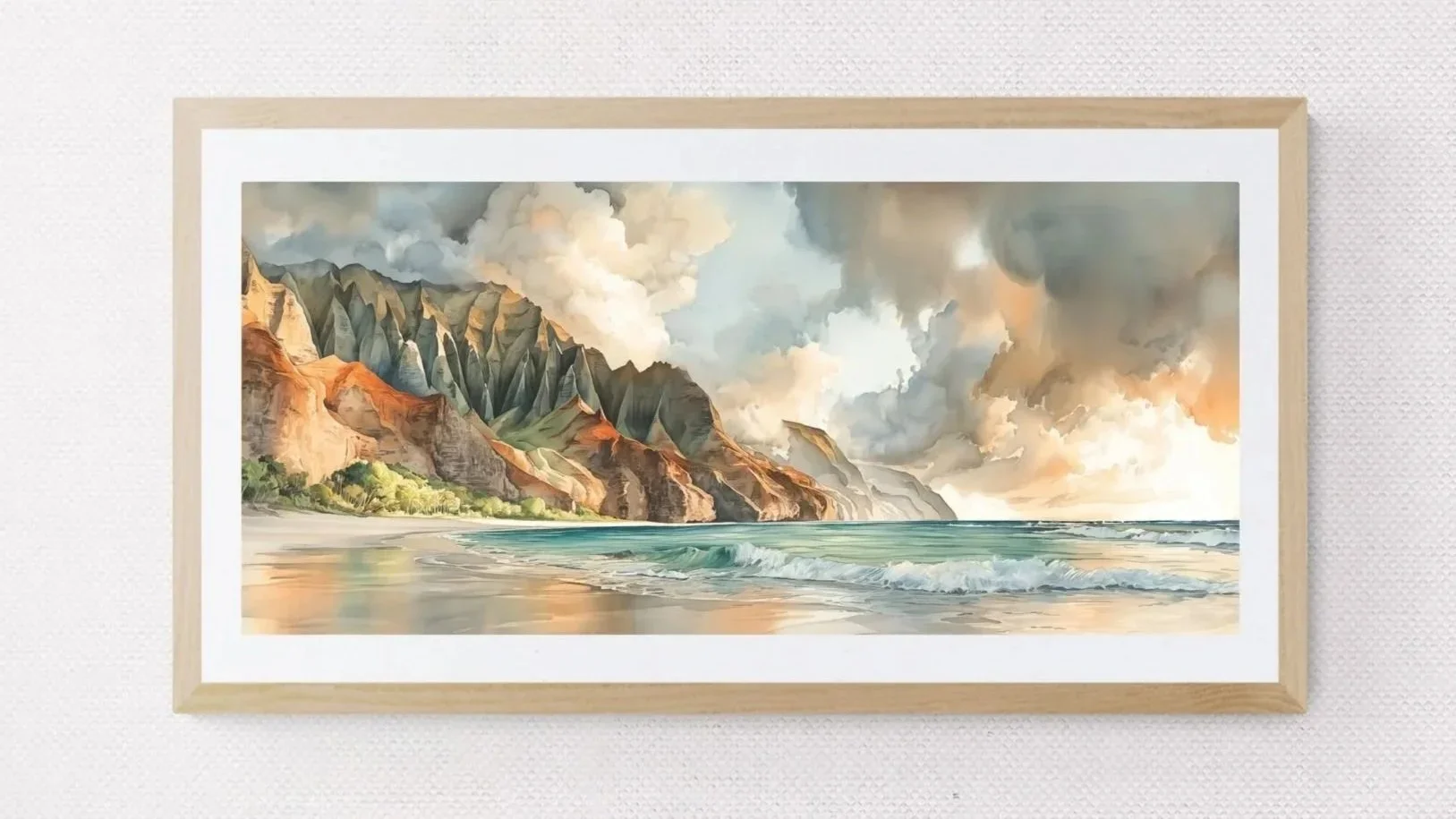
Two ways to give a landscape more room
A broad landscape can become the focal point of a room in more than one form. A panorama presents the view as one continuous artwork. A triptych divides a composition across three separate panels.
Both can work above a sofa, sideboard, or another generous stretch of wall. The difference is how the image moves across that space and how the arrangement feels with the furniture around it.
A panorama: one continuous view
A single-panel panorama keeps the landscape within one uninterrupted composition. Your eye can follow a horizon or a change in colour without moving across a gap between frames.
This format can feel especially comfortable in a simple arrangement where you want one clear focal point. It also gives you a single outside shape to measure and position.
An open coastline, a mountain range, or a quiet stretch of countryside can each take on a different presence in a single wide composition. Check the individual artwork listing for available sizes and finishes.
A triptych: a landscape with rhythm
A triptych carries the scene across three panels. The spaces between them become part of the arrangement, creating a repeated rhythm on the wall.
The three panels should be considered together when choosing size and placement. Add their finished outside widths and the two gaps to find the total width. A consistent spacing and aligned placement help the composition read as one connected landscape.
Compare the complete footprint
Do not compare a single panel’s dimensions with the width of a panorama. Compare the full outside footprint of each finished arrangement.
Mark both options on the wall with painter’s tape. Include frames and gaps. Look from the room’s entrance and your normal seat, and notice which shape sits more comfortably above the furniture.
If the wall has nearby windows, shelves, or changes in height, include those in your test. The empty space around the artwork matters as much as its width.
Think about installation and finish
A panorama involves positioning one artwork. A triptych involves positioning three and keeping their relationship consistent. The appropriate hardware and installation method depend on the selected product, its weight, and your wall; follow the supplied instructions.
Then compare finishes. A framed paper piece and a float-framed canvas can give the same landscape a different surface and edge. Check each product listing rather than assuming that every image is offered in every format.
Let the room and the landscape decide
Choose a panorama if you are drawn to the calm of one continuous scene. Choose a triptych if you enjoy the structure of three connected panels. Try the full proportions on your wall, then select the artwork you want to return to every day.